
Creatine gummies have become one of the fastest-growing supplement formats, and the reason is easy to understand: they taste like candy, they need no shaker bottle, and they photograph well. The problem almost nobody mentions is dosing. The research-supported amount of creatine monohydrate is about 3 to 5 grams per day for most adults, and most gummies contain roughly 1 to 1.5 grams each, which means a "serving" of gummies is often several pieces and a fraction of the daily target (Healthline, 2026). Powder, by contrast, delivers the full amount in one scoop for pennies. This article walks through the label math step by step, compares cost per actual gram of creatine, and identifies the cases where gummies genuinely are the better choice, because for some people they are.
Creatine itself is one of the best-studied supplements in existence, with decades of research supporting modest strength and performance benefits and a strong safety record at normal doses (Kreider et al., 2017). For years it came almost exclusively as a cheap, slightly gritty, unflavored powder. Gummies changed the experience: pre-flavored, pre-portioned, no chalky texture, and easy to take without water. That matters more than it sounds, because a supplement you actually take every day beats a slightly better one you abandon. The popularity is also social; gummies are visible and shareable in a way a tub of powder never was. Convenience is a real benefit, and this article is not here to take that away. It is here to make sure the dose you think you are taking is the dose you are actually taking.
Here is the arithmetic the ads leave out. Most creatine gummies on the market contain about 1 to 1.5 grams of creatine monohydrate per gummy, with some products at 2 to 2.5 grams and a few under 1 gram (Healthline, 2026). The commonly used daily amount is 3 to 5 grams (Kreider et al., 2017). Put those together and the "serving" on the front of the jar often is not a day's supply.
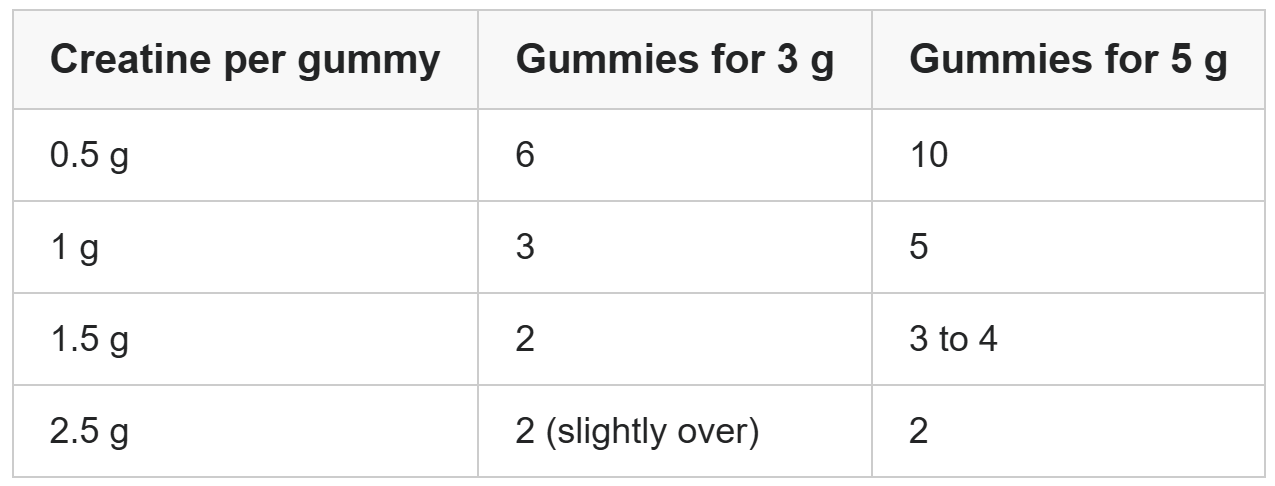
Read the label in this order: find the grams of creatine monohydrate per serving, then find how many gummies make one serving, then multiply out what a day actually requires. A product advertising "5 g per serving" is fine, unless one serving is six gummies and the jar holds 60, in which case the jar is a ten-day supply.
Three numbers hide behind the front-of-jar claims. First, creatine per single gummy versus per serving: a "3 g" claim spread across four gummies is 0.75 g each, which changes your math and your chewing. Second, sugar and calories: because gummies need binders, flavoring, and sweetness, several gummies a day add sugar and calories that a scoop of unflavored powder does not, which is not a dealbreaker for most people but is worth knowing if you take them daily for years. Third, and most uncomfortable, whether the contents match the label at all. Gummies are a harder format to manufacture accurately than powder, because creatine is dense and gummy bases are complex, and lawsuits have been filed in recent years alleging that some gummy supplement brands contained less of the active ingredient than the label claimed (Healthline, 2026). It should be noted those suits are allegations, not settled facts, and this article names no brands. The reasonable takeaway is simply that label accuracy in gummy format has been questioned, which is one more reason the per-gram math matters.
Price comparisons in ads use serving counts, which flatters gummies. Cost per gram of actual creatine is the honest unit. Generic creatine monohydrate powder commonly works out to very roughly $0.03 to $0.06 per gram, so a 5-gram daily habit costs around 15 to 30 cents a day, or about $5 to $9 a month. Gummies carry flavoring, gelatin, and packaging, and typically work out to several times more per gram of creatine; a jar that looks reasonably priced per serving often costs $1 or more per gram of actual creatine once you count gummies rather than servings, putting the same 5 grams closer to $1.50 to $3 a day. Capsules sit in between, usually worse than powder and sometimes better than gummies, with the added burden of swallowing many pills for one dose. Prices vary a lot by brand and retailer, so run this math on the actual products in front of you rather than quoting anyone's exact numbers, including ours.
The honest answer is that gummies are a fine choice for some people. If you travel constantly and a shaker bottle is not happening, a sealed pack of gummies in a bag is far better than missed days. If you genuinely will not drink a gritty drink, a creatine habit you keep beats one you quit. And for people who already take several supplements as gummies, adding one more is low friction. The case against gummies is not that they are bad; it is that they are expensive per gram, often underdosed per serving, and easy to under-take when the label math is opaque. If you know all three and choose them anyway, that is a sensible decision, not a mistake.
Three things separate a defensible gummy from an expensive candy. First, dose disclosure: the label should state grams of creatine monohydrate per serving and per gummy, not a proprietary blend. Second, third-party testing: look for certification from an independent program that checks identity and content, since gummy format label accuracy has been legally challenged. Third, serving count honesty: divide the number of gummies in the container by the gummies you will actually eat per day, and check the true monthly cost against powder before deciding.
Creatine works, and the form you take it in matters far less than taking it consistently at roughly 3 to 5 grams a day (Kreider et al., 2017). Powder wins on cost and dose precision, gummies win on convenience and adherence for people who will actually take them, and the label math is what turns either choice into an informed one. For the deeper science behind creatine, see our full guide to creatine for body and brain, and for context on how supplements are marketed, our free evidence-based guide to popular fitness supplements covers creatine and its neighbors. If you want the complete foundation in reading claims like these, the Innova Vita Health and Wellness Education course is the flagship resource we built for exactly that.
Do the per-gummy math on any product you own right now. Find grams of creatine per serving, divide by gummies per serving, and multiply by the gummies you would need for 3 to 5 grams. The result may surprise you.
Compare cost per gram, not cost per jar. Divide the price by the total grams of creatine in the container. Powder usually lands around a few cents per gram; gummies often land ten times higher.
Look for third-party testing on the label. Independent certification matters more in gummy format, where label accuracy has been legally challenged in the broader supplement industry.
If you prefer gummies, pick a full-dose format and count the pieces. Some products deliver 2.5 grams per gummy, which shrinks the chew count and the cost gap considerably.
Simplify if this feels like a lot. Unflavored creatine monohydrate powder stirred into any drink you already have, taken daily, meets the evidence base at the lowest cost. Everything above is optional refinement around that core habit.
Adherence — Whether you actually take a supplement or medication consistently over time, which often matters more than small differences in quality.
Creatine monohydrate — The most researched form of creatine, a compound your muscles use to regenerate energy during short, intense efforts.
Label claim — The amount of an ingredient a manufacturer states on the packaging, which for supplements is not verified by the FDA before sale.
Proprietary blend — A label listing that hides individual ingredient amounts behind a blend name; a red flag for dose transparency.
Serving size — The amount of a product the label defines as one serving, which may differ from the amount needed for a research-supported dose.
Third-party testing — Independent laboratory verification that a supplement contains what its label claims, often shown as a certification mark.
Healthline. (2026). Creatine gummies vs. creatine powder: Which is best? https://www.healthline.com/health/creatine-gummies-vs-powder
Kreider, R. B., et al. (2017). International Society of Sports Nutrition position stand: Safety and efficacy of creatine supplementation in exercise, sport, and medicine. Journal of the International Society of Sports Nutrition, 14, Article 18. https://doi.org/10.1186/s12970-017-0189-8

Chris Bigelow holds a master’s degree in kinesiology from A.T. Still University and has taught kinesiology and exercise science at Bryan University for more than 10 years. He founded Innova Vita Fitness to make evidence-based health, fitness and research education more accessible to adult learners. His work focuses on exercise science, health literacy, sustainable behavior change and helping beginners evaluate health information more confidently.
 Click Here