.png)
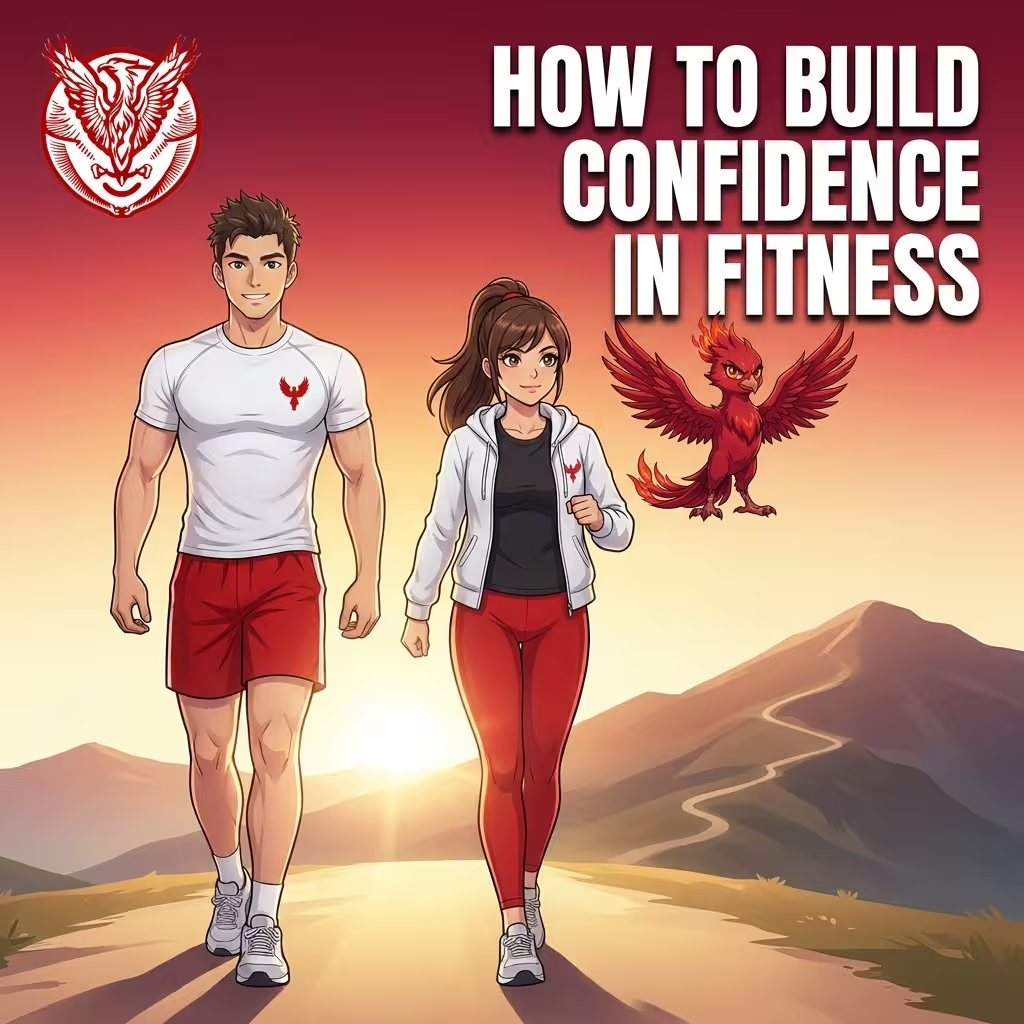
If you've ever started a workout routine only to quit a few weeks later, or promised yourself you'd eat better but found yourself back at square one by the weekend, you're not alone, and the problem probably isn't willpower or laziness. What might be missing is something psychologists call self-efficacy, and understanding it could be the key to finally making those healthy habits stick.
Self-efficacy is your belief in your own ability to succeed at a specific task or challenge. Warner and Schwarzer (2020) describe it as the sense of control you have over difficult situations through your own competent behavior, or more simply, your "can-do cognition." When it comes to health and fitness, self-efficacy is the quiet voice that says "I can do this" when you're deciding whether to go for that walk or skip it, whether to order the salad or the burger, whether to try one more time after you've stumbled. People with high self-efficacy choose more ambitious goals, put in more effort to reach them, and bounce back faster when things go wrong (Warner & Schwarzer, 2020). They see opportunities where others see obstacles, and when they hit a roadblock, they find a way around it instead of giving up entirely.
This matters because your beliefs about what you can do actually shape what you will do. Self-efficacy affects how you feel before a challenge, how you think about it, and ultimately whether you try at all and how long you stick with it. Research has shown that self-efficacy is one of the strongest predictors of whether someone will adopt and maintain healthy behaviors like regular exercise, eating more vegetables, or managing a chronic condition (Warner & Schwarzer, 2020). It's become such a powerful idea that nearly every major theory about health behavior change now includes it as a key ingredient.
The good news is that self-efficacy isn't fixed. According to Albert Bandura, the psychologist who developed the concept, there are four main sources that feed your sense of capability: mastery experiences (your own past successes), vicarious experiences (watching others succeed), verbal persuasion (encouragement from others), and somatic and affective states (how your body feels). While all four matter, mastery and vicarious experiences are typically the most powerful and accessible in everyday life.
Mastery experiences are simply times when you've successfully done something, especially something that felt hard or new. Every time you complete a workout you weren't sure you could finish or pack a healthy lunch instead of ordering takeout, you're building evidence that you're capable. Over time, these small wins create a foundation of confidence that makes the next challenge feel less intimidating.

Here's the critical part most people miss: mastery experiences don't have to be big. You don't need to run a marathon or lose fifty pounds to build self-efficacy. In fact, starting too big is one of the fastest ways to undermine it. The goal is to set yourself up for wins, and that means making the bar low enough that you can clear it, then gradually raising it as you get stronger. If you haven't exercised in years, a mastery experience might be putting on your tennis shoes and walking around the block. If you tend to skip breakfast and crash by midmorning, it might be eating a single piece of fruit before you leave the house. These actions might sound trivially small, but that's exactly the point. Small, achievable actions create success, success builds confidence, and confidence makes you willing to try something slightly harder next time (Warner & Schwarzer, 2020). This creates what Bandura called a "self-manifesting mechanism," where high self-efficacy leads to more effort and better outcomes, which then increases self-efficacy even further in an upward spiral.
There's another key element to making mastery work: how you explain your successes and failures to yourself. This is called your attributional style. Self-efficacy only increases when you attribute your successes to internal causes, meaning you give yourself credit for what you accomplished (Warner & Schwarzer, 2020). If you finish that walk and tell yourself "I only did it because the weather was nice," you're robbing yourself of the confidence boost you earned. Conversely, if you skip a workout and tell yourself "I'm just lazy" or "I'll never be a fitness person," you're reinforcing the belief that you can't succeed. The healthier pattern is to own your wins ("I made that happen, I chose to go even though I was tired") and externalize your slip-ups ("I had a rough day at work, the timing was bad, I'll plan better next time"). This isn't about making excuses, it's about protecting your belief in your ability to succeed so that one bad day doesn't spiral into giving up entirely. Researchers have found that interventions can teach people to reframe lapses as temporary and situational rather than as proof of incapability, helping them avoid what's called the abstinence-violation effect, where one slip leads to a full relapse because people see it as evidence they were never capable in the first place (Marlatt & Gordon, 1985 as cited in Warner & Schwarzer, 2020).
The second major source of self-efficacy is vicarious experience, which basically means learning by watching others. When you see someone else successfully do something you want to do, especially someone similar to you, it increases your belief that you can do it too. If you've ever watched a YouTube workout video and thought "okay, if they can do it, maybe I can too," or scrolled past someone's before-and-after photos and felt a spark of motivation, you've had a vicarious experience. Social media can be useful for this, but remember that these people aren't perfect and they aren't you - they can still provide motivation without being identical to your situation.
Similarity matters a lot too. Bandura's research shows that role models who resemble you in background, age, gender, or starting fitness level tend to have a stronger effect on your self-efficacy than those who seem too different. If you're a fifty-year-old woman who hasn't exercised in a decade, watching a professional athlete crush a high-intensity workout might be impressive, but it probably won't convince you that you can do the same. Seeing another fifty-year-old woman talk about how she started with ten-minute walks and worked her way up to hiking on weekends hits different. It feels achievable because the person doing it is someone you can relate to, and their journey shows you a realistic path forward.
You can actively seek out vicarious experiences. Join an online fitness community for beginners where people share their small wins and struggles. Facebook is full of these. Follow social media accounts from people at your fitness level rather than just elite athletes. If you're trying to eat healthier, watch cooking videos from people who are learning too, not just celebrity chefs who make it look effortless. The more you see people like you succeeding, the more your brain starts to believe "if they can, maybe I can too."

Vicarious experiences also work through mental imagery. Research has shown that imagining yourself successfully performing a behavior, step by step, can actually increase your self-efficacy for that behavior (Chan & Cameron, 2012 as cited in Warner & Schwarzer, 2020). This is called process imagery which is picturing not just the end result but the specific actions you'll take to get there. For example, if you want to start going to the gym in the mornings, you could spend a few minutes visualizing the entire sequence: hearing your alarm, getting out of bed, putting on your workout clothes, driving to the gym, walking in, starting your warmup. This mental rehearsal helps your brain treat the behavior as more familiar and doable. The combination of watching others succeed and imagining yourself succeeding creates a powerful combo for building belief in your abilities.
Self-efficacy also comes from verbal persuasion. This is when someone you trust expresses confidence in your abilities. Hearing "I know you can do this" from a doctor, trainer, or close friend can give you a temporary boost, though it's less powerful than actually succeeding yourself. Your physical sensations matter too. If your heart is racing and your palms are sweaty before a workout, you might interpret that as a sign you're not ready, even though it's just normal nervousness. Learning to reinterpret those sensations as excitement rather than fear can help you feel more capable (Warner & Schwarzer, 2020).
One of the most important things to understand is that self-efficacy isn't the same as ability. You don't have to be naturally good at something to have high self-efficacy for it. Self-efficacy is your belief in your capacity to learn, improve, and succeed, which means you can build confidence even if you're starting from zero. Every expert started as a beginner. The difference is that people with high self-efficacy are willing to try, to fail, to try again, and to keep going long enough to get better.
Pick one health behavior you want to work on, and choose the smallest possible version of it that you're confident you can do. Write it down, do it, and give yourself full credit for following through. Do it again tomorrow. After a week of small wins, raise the bar just slightly. Alongside that, seek out vicarious experiences. Find people who've walked a path similar to the one you want to walk and learn from their example. Pay attention to how you talk to yourself about your progress. Celebrate your wins as proof of your capability, and treat your setbacks as temporary and situational rather than as evidence of failure.
The research is clear: self-efficacy is one of the strongest predictors of whether you'll succeed in changing your health behaviors, and it's something you can actively build through small, intentional actions (Warner & Schwarzer, 2020). You don't need to overhaul your entire life overnight. You just need to start where you are, prove to yourself that you can take one step, and then take the next one.
Start with a "stupid small" mastery goal — Choose one health behavior and make your first goal so easy it feels almost silly. If you want to exercise, commit to putting on your workout clothes and doing one pushup, or walking for two minutes. If it's nutrition, eat one serving of vegetables today, or drink one extra glass of water. The goal is to guarantee yourself a win, because that win builds confidence for the next attempt.
Track your mastery wins and claim them — Keep a simple log (a note on your phone, a checkmark on a calendar) every time you follow through on your commitment, and take a moment to consciously tell yourself "I did that. That was me. I'm capable." This reinforces the internal attribution that builds self-efficacy.
Find your fitness doppelgänger — Identify someone who's a few steps ahead of you on the path you want to take, someone whose starting point and circumstances feel similar to yours, and follow their journey. This could be a friend, a YouTuber, someone in an online community, or even a fictional character in a testimonial video. Watch what they do, notice the strategies they use, and remind yourself that if they can do it, you probably can too.
Mentally rehearse your next challenge — Spend three to five minutes before bed or in the morning visualizing yourself successfully completing your next healthy behavior. Picture each step in detail, from start to finish, and imagine it going well. See yourself lacing up your shoes, feeling the pavement under your feet, finishing the walk, and feeling proud.
Reframe your slip-ups externally — The next time you skip a workout or break a healthy eating streak, practice explaining it to yourself in terms of the situation, not your character. Instead of "I'm so lazy" or "I'll never change," try "I had a stressful day and didn't plan well" or "That was harder than I expected, I'll try a smaller version next time." This keeps your self-efficacy intact so one bad day doesn't spiral into giving up.
Abstinence-violation effect — The tendency to see a single lapse or slip-up as complete failure and proof of incapability, which often leads people to give up entirely rather than getting back on track. Named by researchers Marlatt and Gordon (1985 as cited in Warner & Schwarzer, 2020) to describe how one missed workout or one unhealthy meal can spiral into abandoning the goal altogether if you interpret it as evidence you were never capable in the first place.
Affective states — The emotional and mood-related feelings you experience, like anxiety, excitement, or calmness. In the context of self-efficacy, how you feel before or during a challenge can influence whether you believe you can succeed.
Approach imagery — A mental technique where you imagine the positive outcomes or benefits of completing a behavior, such as picturing how good you'll feel after a workout. Research shows this can increase motivation and self-efficacy (Chan & Cameron, 2012 as cited in Warner & Schwarzer, 2020).
Attributional style — The habitual way you explain the causes of events, especially your successes and failures. A healthy attributional style for building self-efficacy means taking internal credit for successes while attributing failures to external or temporary factors rather than to unchangeable personal flaws.
Graded mastery — An intervention technique where a challenging task is broken down into progressively harder steps, starting with something very easy and gradually increasing the difficulty. The goal is to ensure early successes that build confidence before moving to harder challenges.
Internal attribution — Explaining an outcome as being caused by something within yourself, such as your effort, ability, or choices. For self-efficacy to grow, you need to internally attribute your successes. If you externally attribute them ("I only succeeded because I got lucky"), your confidence won't increase.
Mastery experience — A personal success at performing a behavior or completing a task, especially one that felt difficult or new. These are considered the most powerful source of self-efficacy because they give you authentic proof that you can handle a challenge.
Process imagery — A mental rehearsal technique where you visualize the specific steps and actions required to complete a behavior, from start to finish. For example, imagining yourself waking up, putting on workout clothes, driving to the gym, and starting your warmup.
Self-efficacy — Your belief in your own ability to successfully perform a specific behavior or handle a particular challenge. It's not about whether you're actually skilled, but whether you believe you can succeed. High self-efficacy makes you more likely to set goals, try hard, persist when things get tough, and ultimately succeed at health behaviors (Warner & Schwarzer, 2020).
Self-manifesting mechanism — A positive feedback loop where high self-efficacy leads to more effort and better outcomes, which then increases self-efficacy even further, creating an upward spiral.
Somatic states — The physical sensations you experience in your body, such as a racing heart, sweaty palms, muscle tension, or fatigue. These sensations can be interpreted as either signs of readiness and excitement or as evidence of stress and unpreparedness, depending on how you frame them.
Verbal persuasion — Encouragement or expressions of confidence in your abilities from another person. When someone you trust tells you "I know you can do this," it can temporarily boost your belief in yourself, though it's not as powerful as actually succeeding yourself (Warner & Schwarzer, 2020).
Vicarious experience — Learning and gaining confidence by watching someone else successfully perform a behavior, either in person or through videos, testimonials, or stories. This works best when the role model resembles you in age, background, or starting fitness level, making their success feel more achievable.
Warner, L. M., & Schwarzer, R. (2020). Self-efficacy and health. In K. Sweeny, M. L. Robbins, & L. M. Cohen (Eds.), The Wiley Encyclopedia of Health Psychology: Volume II, The Social Bases of Health Behavior (pp. 605-613). Wiley-Blackwell. https://doi.org/10.1002/9781119057840.ch111

Chris Bigelow holds a master’s degree in kinesiology from A.T. Still University and has taught kinesiology and exercise science at Bryan University for more than 10 years. He founded Innova Vita Fitness to make evidence-based health, fitness and research education more accessible to adult learners. His work focuses on exercise science, health literacy, sustainable behavior change and helping beginners evaluate health information more confidently.