The 2025-2030 Dietary Guidelines for Americans, released January 7, 2026, changed the federal protein advice in a way no edition had done before: instead of only naming protein foods to eat, they now set a daily protein amount, 1.2 to 1.6 grams per kilogram of body weight per day, for adults to aim for (U.S. Department of Health and Human Services and U.S. Department of Agriculture [HHS and USDA], 2026). If you weigh 176 pounds (80 kilograms), that works out to roughly 96 to 128 grams of protein a day. This article explains what the new guidelines actually say, how the number compares to the old advice, what it means for your body weight, and how to reach it without weighing every bite of food.

The new guidelines, released on January 7, 2026, include a section called "Prioritize Protein Foods at Every Meal" with the exact language: "Protein serving goals: 1.2–1.6 grams of protein per kilogram of body weight per day, adjusting as needed based on your individual caloric requirements" (HHS and USDA, 2026, p. 2). The document also instructs readers to "prioritize high-quality, nutrient-dense protein foods as part of a healthy dietary pattern," naming both animal sources (eggs, poultry, seafood, red meat) and plant sources (beans, peas, lentils, legumes, nuts, seeds, and soy) (HHS and USDA, 2026, p. 2).
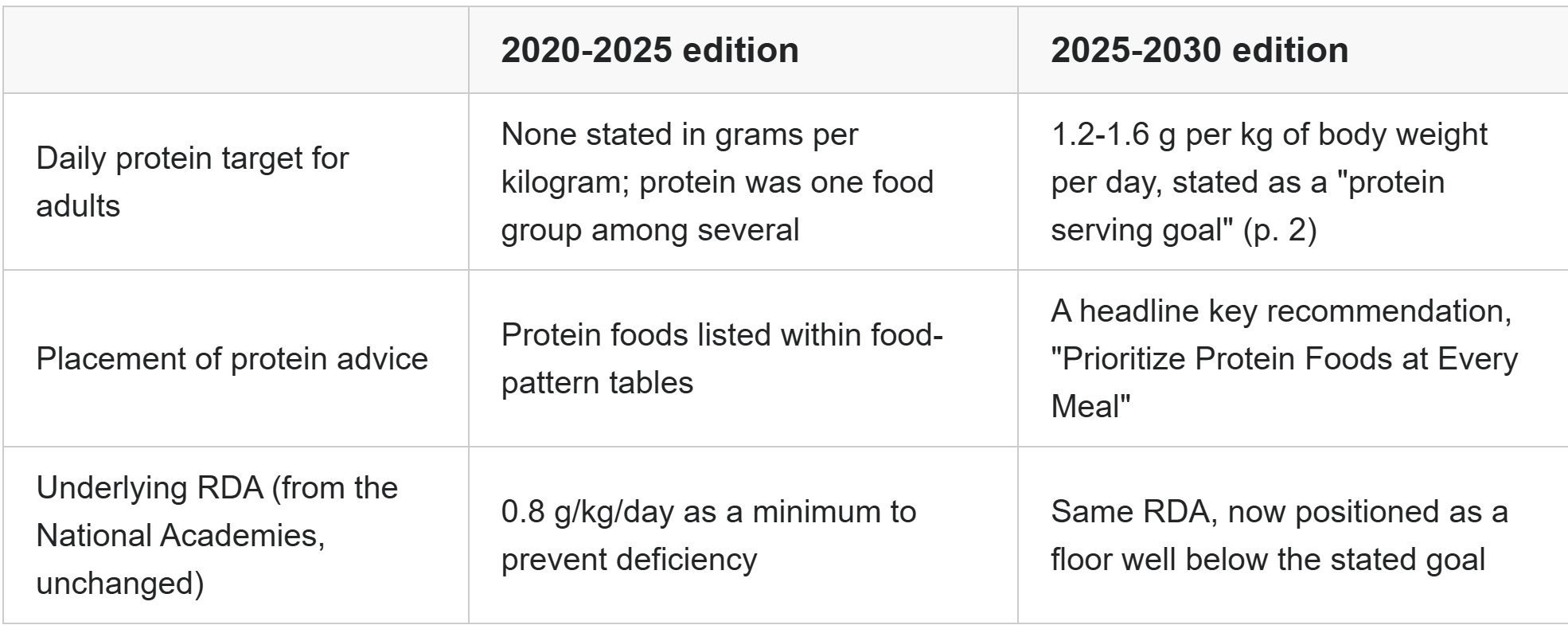
So yes, the protein advice changed, and it changed in a specific direction: upward. The 2020-2025 edition never gave adults a daily protein target in grams per kilogram at all; it pointed to protein foods as one of several food groups and left amounts in food-pattern tables. The widely quoted 0.8 grams per kilogram per day figure comes from the Recommended Dietary Allowance (RDA), the National Academy of Sciences' estimate of the minimum most healthy adults need to avoid deficiency, and it was never a fitness or body-composition target (Pasiakos, 2026). The new guidelines' 1.2 to 1.6 grams per kilogram is 50 to 100 percent above that old minimum, which is exactly why the change got attention (Harvard T.H. Chan School of Public Health, 2026).
Two honest caveats belong here. First, the guidelines reaffirmed that protein can reasonably supply 10 to 35 percent of daily calories, and the 1.2 to 1.6 gram figure is described as a goal, not a requirement (University of Arkansas System Division of Agriculture, 2026). Second, the change has critics. Nutrition researchers at Harvard note that protein needs vary a lot from person to person, that excess protein can be stored as fat like any excess calorie, and that the guidelines pay little attention to protein quality, since plant proteins and fish have been associated with better long-term health outcomes than diets high in red meat (Harvard T.H. Chan School of Public Health, 2026). Both the goal and the criticism are worth knowing before you restructure your diet around one number.
Grams per kilogram sounds abstract until you run your own numbers. One kilogram is 2.2 pounds, so divide your weight in pounds by 2.2 to get kilograms, then multiply by 1.2 and by 1.6 to get your daily range. Three worked examples:
If you prefer not to convert, multiply your weight in pounds by 0.55 for the low end and 0.73 for the high end of the range. It should be noted that the guidelines say to adjust based on your individual caloric requirements, and that people with kidney disease or other medical conditions affecting protein handling are a genuine exception: the population-level figure was not set for you, and your protein target is a conversation with your doctor or a registered dietitian, not a formula (Harvard T.H. Chan School of Public Health, 2026).
The 0.8 grams per kilogram RDA is a floor, the amount that prevents deficiency in most healthy adults, and the new guidelines clearly treated it that way when setting a goal 50 to 100 percent higher (Pasiakos, 2026). Beyond that floor, needs shift with circumstances. The guidelines give older adults their own instruction, noting that some older adults "need fewer calories but still require equal or greater amounts of key nutrients such as protein" and should prioritize protein-rich foods accordingly (HHS and USDA, 2026, p. 8). Adults doing regular resistance training have long been advised toward the upper part of the new range, around 1.6 grams per kilogram, in the meta-analysis evidence on building muscle (Morton et al., 2018), and we walk through that evidence in our article on calculating optimal protein intake for muscle growth. People losing weight also benefit from the higher end, because higher protein intake during a calorie deficit helps preserve muscle, which becomes the central issue when the deficit comes from appetite-suppressing medication, the subject of our article on GLP-1 agonists and preventing muscle loss. The single number that fits every body and every goal does not exist; ranges exist, and circumstances pick your spot in the range.
Surveys suggest most American adults eat more than the RDA already, but the daily total hides the problem: the distribution (Harvard T.H. Chan School of Public Health, 2026). A typical pattern is a breakfast of toast or cereal with 10 or 15 grams of protein, a modest lunch, and a large dinner where most of the day's protein lands at once. Muscle protein synthesis works better with protein spread across meals than with one large evening dose, and the guidelines' "at every meal" phrasing points at exactly this gap. The shortfall in a typical day is usually breakfast, plus whatever snacks displace protein rather than add to it. If your dinner has the 40 or 50 grams you need and breakfast has 12, the fix is not more dinner; it is a breakfast with eggs, Greek yogurt, or cottage cheese, which is the practical difference between hitting the range and merely averaging it.
Full macro tracking works, but most people quit it within weeks, so here is the lighter version: pick two or three anchor foods, foods you already eat most days, learn their protein content once, and build each meal around one of them. An egg has about 6 grams, a cup of Greek yogurt about 20, a 3-ounce chicken breast about 26, a cup of cooked lentils about 18, and a cup of milk about 8. If every meal contains one anchor in a meaningful portion, most people land inside their range without logging anything. Our macronutrient calculator can convert your new protein range into a full calorie and macro picture if you want the complete version. Three example days at roughly 110 grams of protein for a 176-pound reader: a scrambled-eggs-and-yogurt breakfast, chicken-at-lunch day; a yogurt-and-fruit breakfast, lentil-soup lunch day; or a higher-protein breakfast cereal with milk, salmon-dinner day. Each one uses the same anchors in different arrangements, which is the point: the habit survives because the food stays familiar.
The 2025-2030 Dietary Guidelines made protein the first headline of their nutrition advice, setting a goal of 1.2 to 1.6 grams per kilogram of body weight per day and asking Americans to put protein at every meal (HHS and USDA, 2026). The RDA of 0.8 grams per kilogram still exists underneath as the deficiency-prevention minimum, and the new goal sits well above it by design. Run your own weight through the formula, look for the breakfast gap first, and adjust with your own clinician or dietitian if you have any medical condition that touches protein metabolism. For a deeper read on the guidelines themselves, see our news analysis of the 2025-2030 Dietary Guidelines, for the number in the context of your full diet, the macronutrient calculator does the conversion, and the complete Health and Wellness Education course teaches the nutrition fundamentals this article assumes.
Calculate your range once, in pounds, and write it down. Multiply your weight in pounds by 0.55 and 0.73 to get your low and high daily protein goals. For a 180-pound reader, that is about 99 to 131 grams.
Audit your breakfast before anything else. For most people, breakfast carries the least protein of the day. Adding one anchor food, like Greek yogurt or eggs, is usually the single cheapest fix.
Learn three anchor foods and stop counting. Memorize the protein in three foods you already eat, then build each meal around one. Full tracking is optional; anchors are the habit that lasts. If you want the complete version, the macronutrient calculator turns your range into daily calorie and macro targets.
Shift some protein toward the end of the day if you train. Active readers doing resistance work benefit from protein across the day rather than one large evening dose, which matches the guidelines' "every meal" language.
Talk to a doctor or dietitian about exceptions. Kidney disease, pregnancy, and several medical conditions change the target. The guidelines' range is a population-level goal, not a personal prescription.
Recommended Dietary Allowance (RDA) — The daily intake level of a nutrient estimated to meet the needs of nearly all healthy people; a minimum to prevent deficiency, not an optimum.
Dietary Guidelines for Americans — The federal nutrition policy document, updated every five years, that shapes school meals, federal programs and mainstream dietary advice.
Grams per kilogram (g/kg) — A way of expressing nutrient targets relative to body weight, so one number works for people of different sizes.
Macronutrient — One of the three calorie-containing nutrient classes: protein, carbohydrate, and fat.
Muscle protein synthesis — The process by which your body builds and maintains muscle tissue, which responds to protein intake and resistance training.
Nutrient-dense — Describing foods that deliver a high amount of nutrients relative to their calories.
Harvard T.H. Chan School of Public Health. (2026, January 9). Dietary Guidelines for Americans 2025-2030: Progress on some fronts, contradictions on others. The Nutrition Source. https://nutritionsource.hsph.harvard.edu/2026/01/09/dietary-guidelines-for-americans-2025-2030/
Morton, R. W., Murphy, K. T., McKellar, S. R., Schoenfeld, B. J., Henselmans, M., Helms, E., Aragon, A. A., Devries, M. C., Sabin, L., Miller, J. W., & Phillips, S. M. (2018). A systematic review, meta-analysis and meta-regression of the effect of protein supplementation on resistance training-induced gains in muscle mass and strength. British Journal of Sports Medicine, 52(6), 376–384. https://doi.org/10.1136/bjsports-2017-097608
Pasiakos, S. M., Davis, T. A., Klurfeld, D. M., Neuhouser, M. L., Rodriguez, N. R., & Tomé, D. (2026). Perspectives on the Protein Recommendations in the 2025-2030 Dietary Guidelines for Americans. The Journal of Nutrition, 101754. https://jn.nutrition.org/article/S0022-3166(26)00403-7/fulltext
U.S. Department of Health and Human Services and U.S. Department of Agriculture. (2026). Dietary Guidelines for Americans, 2025-2030. https://cdn.realfood.gov/DGA.pdf
University of Arkansas System Division of Agriculture. (2026). Taking protein into account with the new food pyramid. https://aaes.uada.edu/news/protein-new-food-pyramid/

Chris Bigelow holds a master’s degree in kinesiology from A.T. Still University and has taught kinesiology and exercise science at Bryan University for more than 10 years. He founded Innova Vita Fitness to make evidence-based health, fitness and research education more accessible to adult learners. His work focuses on exercise science, health literacy, sustainable behavior change and helping beginners evaluate health information more confidently.