.png)
Why Does This Matter?
How did we arrive at a point where nearly 90% of U.S. healthcare spending addresses chronic disease, much of it preventable through dietary intervention? This question sits at the heart of the newly released Dietary Guidelines for Americans, 2025–2030, unveiled on January 7, 2026, by the U.S. Department of Health and Human Services (HHS) and the U.S. Department of Agriculture (USDA). The guidelines represent what officials are calling "the most significant reset of federal nutrition policy in decades," pivoting away from decades of low-fat, grain-centric recommendations toward an emphasis on whole, minimally processed foods rich in protein, healthy fats, and micronutrients (HHS, 2026a).
In my view, this policy shift warrants serious attention from practitioners not simply because it represents a bureaucratic repositioning, but because it reflects a growing body of evidence linking ultra-processed food consumption to adverse health outcomes across virtually every physiological system. When we consider that more than 70% of American adults are now classified as overweight or obese, that nearly one in three adolescents presents with prediabetes, and that 77% of military-aged youth are ineligible for service primarily due to diet-related chronic conditions, the urgency becomes clear (HHS, 2026b). These are not abstract statistics—they represent patients in our clinics, clients in our training facilities, and communities grappling with metabolic dysfunction at unprecedented scales.
What happens when public health policy finally catches up with nutrition science? The release of the 2025–2030 Dietary Guidelines signals a deliberate departure from the pharmaceutical and processed-food paradigms that have dominated federal nutrition recommendations for the past half-century. According to HHS Secretary Robert F. Kennedy, Jr., and USDA Secretary Brooke Rollins, the new guidelines deliver "a clear, common-sense message to the American people: eat real food" (HHS, 2026a). This represents a fundamental reorientation—not merely a tweaking of macronutrient ratios or portion sizes, but a wholesale reconsideration of what constitutes nourishment in the context of a national health emergency.
The rationale is straightforward. The United States currently spends 48% of all federal tax dollars on healthcare, with 90% of that expenditure directed toward managing chronic diseases, many of which are preventable or reversible through dietary modification (HHS, 2026b). To put this into context, Americans spend 2.5 times more per capita on healthcare than the average citizen of other developed nations, yet our life expectancy trails by four years (HHS, 2026b). The childhood obesity rate in the U.S. is nearly five times higher than in countries like France, and one-third of American teenagers now meet diagnostic criteria for prediabetes (HHS, 2026b). These are not genetic inevitabilities—they are the consequences of a food environment saturated with hyper-palatable, nutrient-poor products engineered for profit rather than health.
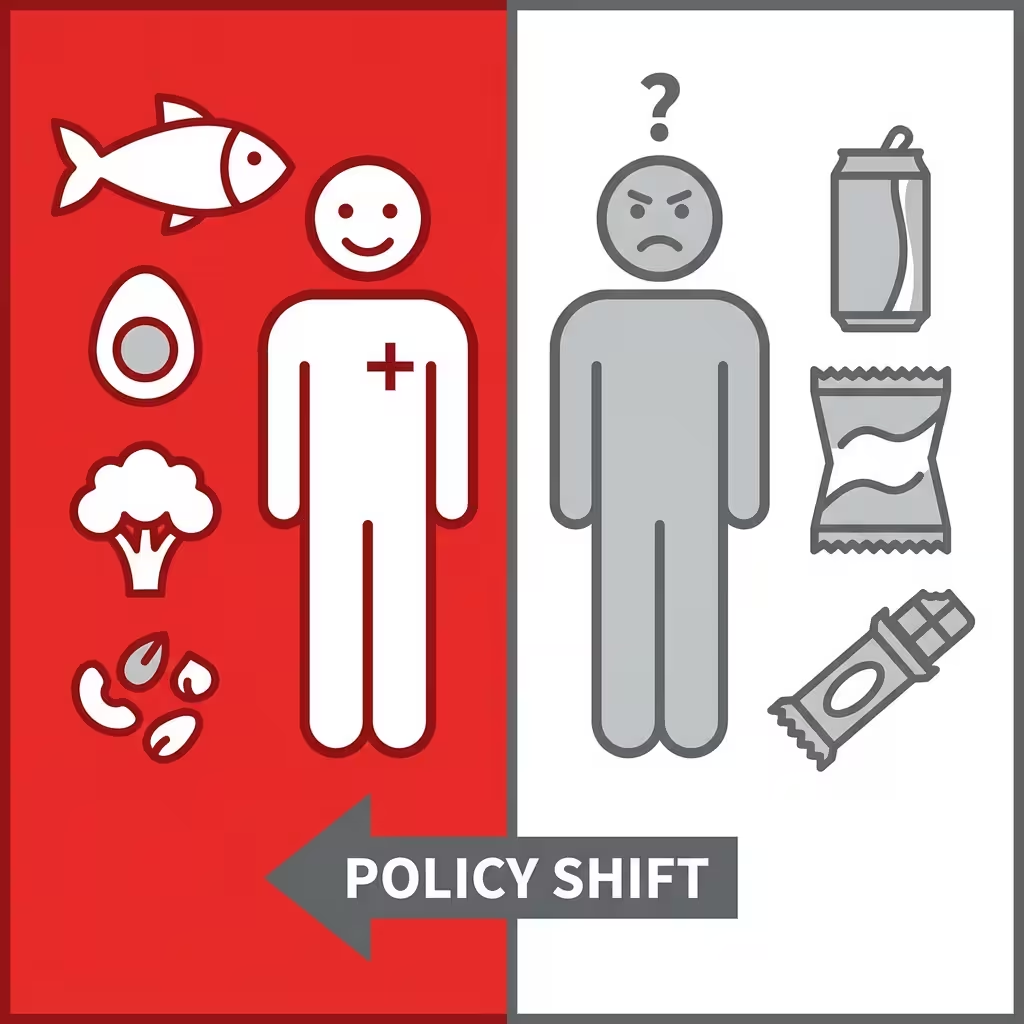
The new guidelines prioritize nine core dietary principles, each grounded in what officials describe as "modern nutrition science" (HHS, 2026a). The first and most prominent recommendation is to prioritize protein at every meal. Unlike previous iterations of the Dietary Guidelines, which minimized protein in favor of carbohydrate-dense foods, the 2025–2030 edition explicitly endorses high-quality, nutrient-dense protein from both animal and plant sources, including eggs, poultry, seafood, red meat, beans, legumes, nuts, seeds, and soy (HHS, 2026b). This shift acknowledges decades of research demonstrating protein's role in satiety, muscle protein synthesis, metabolic health, and glycemic control—concepts that any practitioner working with athletes or metabolic disease populations will recognize as foundational.
The guidelines also call for the consumption of full-fat dairy with no added sugars, reversing longstanding recommendations to favor low-fat and fat-free dairy products (HHS, 2026a). This change reflects emerging evidence that the demonization of saturated fat was premature and that whole-fat dairy may offer metabolic and cardiovascular benefits when consumed without added sugars. Practitioners should note the emphasis on "no added sugars"—the guidelines are not endorsing sweetened yogurt or flavored milk, but rather whole milk, cheese, and plain yogurt consumed in their minimally processed forms.
Perhaps the most groundbreaking aspect of the new guidelines is their explicit condemnation of highly processed foods. For the first time in the history of federal nutrition policy, the guidelines state unequivocally: "avoid highly processed packaged, prepared, ready-to-eat, or other foods that are salty or sweet" and "avoid sugar-sweetened beverages, such as soda, fruit drinks, and energy drinks" (HHS, 2026b). This language is significant. Previous guidelines hedged, suggesting moderation or portion control. The 2025–2030 edition uses the word "avoid," signaling a policy-level acknowledgment that certain categories of food are incompatible with health. The guidelines go further still, recommending that "no amount of added sugars or non-nutritive sweeteners is recommended or considered part of a healthy or nutritious diet," and advising parents to completely eliminate added sugar for children aged four and under (HHS, 2026b).
The document also addresses healthy fats, instructing consumers to obtain the majority of their fat intake from whole food sources such as meats, poultry, eggs, omega-3-rich seafood, nuts, seeds, full-fat dairy, olives, and avocados (HHS, 2026b). When cooking fats are needed, the guidelines recommend olive oil as the most nutrient-dense option. This represents a stark departure from decades of advice to minimize fat intake and favor industrial seed oils—a shift that aligns with recent meta-analytic evidence on the benefits of monounsaturated and polyunsaturated fats from whole food sources.
Finally, the guidelines advocate for whole grains over refined carbohydrates, advising consumers to "prioritize fiber-rich whole grains" and "significantly reduce the consumption of highly processed, refined carbohydrates, such as white bread, ready-to-eat or packaged breakfast options, flour tortillas, and crackers" (HHS, 2026b). In a particularly notable inclusion, the guidelines acknowledge that "individuals with certain chronic diseases may experience improved health outcomes when following a lower carbohydrate diet" (HHS, 2026b)—a recognition of the therapeutic potential of carbohydrate restriction for conditions like type 2 diabetes, metabolic syndrome, and non-alcoholic fatty liver disease.
In my experience, federal nutrition guidelines rarely make bold, unequivocal statements. The 2025–2030 edition breaks from this tradition by naming ultra-processed foods as public health hazards and by repositioning whole, nutrient-dense foods as the cornerstone of disease prevention and reversal. Whether this policy shift will translate into meaningful changes in school lunch programs, SNAP benefits, military feeding protocols, and other federally funded nutrition programs remains to be seen. But the rhetorical shift is undeniable: the government is now telling Americans, in plain language, that the foods filling their grocery carts and drive-through bags are making them sick.
For practitioners, these guidelines provide a policy-level endorsement of dietary recommendations many of us have been making for years. If you work with clients who are skeptical of "alternative" nutrition advice or who have been told by previous healthcare providers to avoid red meat, eat low-fat dairy, or minimize dietary fat, you now have federal backing for a different approach. Use the guidelines as a conversation starter. Print out the key recommendations and walk clients through them, emphasizing that these are not fringe ideas but official federal policy.
If you work in institutional settings—schools, hospitals, correctional facilities, or eldercare—advocate for menu changes that align with the new guidelines. Push back against vending machines stocked with sugar-sweetened beverages and snack foods. Demand that cafeterias offer full-fat dairy, whole grains, and minimally processed proteins. The guidelines explicitly state that they will serve as the foundation for federal feeding programs, meaning there is now a legal and ethical basis for demanding higher-quality food in these environments (HHS, 2026b).
For clients managing chronic disease, particularly type 2 diabetes, metabolic syndrome, cardiovascular disease, or obesity, the guidelines' acknowledgment of lower-carbohydrate diets provides a valuable entry point for therapeutic dietary intervention. Use this as an opportunity to discuss individualized macronutrient targets, meal timing, and food quality in the context of disease management and reversal.
To understand the significance of the new guidelines, it is essential to examine the research underpinning their recommendations—particularly the growing body of evidence linking ultra-processed food (UPF) consumption to adverse health outcomes. A landmark umbrella review published in The BMJ in 2024 synthesized 45 unique meta-analyses encompassing nearly 10 million participants and found that greater exposure to ultra-processed foods was associated with higher risks of mortality, cardiovascular disease, type 2 diabetes, mental health disorders, obesity, and metabolic dysfunction (Lane et al., 2024). The review identified convincing evidence (the highest classification) for direct associations between UPF consumption and increased risk of cardiovascular disease-related mortality (risk ratio 1.50, 95% CI 1.37–1.63) and type 2 diabetes (dose-response risk ratio 1.12, 95% CI 1.11–1.13), as well as higher prevalence of anxiety and common mental health disorders (Lane et al., 2024).
The mechanisms by which ultra-processed foods drive disease are multifactorial. These products are typically energy-dense, nutrient-poor, and engineered for hyper-palatability, leading to overconsumption and poor satiety signaling. They often contain high levels of added sugars, unhealthy fats, sodium, and artificial additives, all of which have been independently associated with metabolic dysregulation, inflammation, and oxidative stress. When we counsel clients to "eat real food," we are not merely appealing to nostalgia or tradition—we are steering them away from a category of products that the best available science suggests is fundamentally incompatible with long-term health.
How might practitioners apply these findings? First, by recognizing that food quality matters as much as—or more than—caloric quantity. A calorie from a whole food source like salmon, sweet potato, or avocado is metabolically and hormonally distinct from a calorie derived from a sugar-sweetened beverage or a packaged snack cake. Second, by educating clients about the Nova food classification system, which categorizes foods based on the extent and purpose of industrial processing. Teaching clients to identify and avoid ultra-processed foods (Nova Group 4) while prioritizing minimally processed or unprocessed foods (Nova Groups 1 and 2) provides a practical, actionable framework that does not require calorie counting or macronutrient tracking.
HHS. (2026a, January 7). Kennedy, Rollins unveil historic reset of U.S. nutrition policy, put real food back at center of health. U.S. Department of Health and Human Services. https://www.hhs.gov/press-room/historic-reset-federal-nutrition-policy.html
HHS. (2026b, January 7). Fact sheet: Trump administration resets U.S. nutrition policy, puts real food back at the center of health. U.S. Department of Health and Human Services. https://www.hhs.gov/press-room/fact-sheet-historic-reset-federal-nutrition-policy.html
Lane, M. M., Gamage, E., Du, S., Ashtree, D. N., McGuinness, A. J., Gauci, S., Baker, P., Lawrence, M., Rebholz, C. M., Srour, B., Touvier, M., Jacka, F. N., O'Neil, A., Segasby, T., & Marx, W. (2024). Ultra-processed food exposure and adverse health outcomes: Umbrella review of epidemiological meta-analyses. The BMJ, 384, bmj-2023-077310. https://doi.org/10.1136/bmj-2023-077310
The 2025–2030 Dietary Guidelines provide the evidence—but translating federal policy into patient education and community health programming requires infrastructure, structured content, and scalable delivery systems.
For Healthcare Providers: License our research-informed wellness course to support patients' lifestyle modification goals with structured education on nutrition, exercise, and chronic disease prevention. No PHI required, structured to support AKS compliance, flexible distribution options. Not covered by insurance.
For Public Health Departments: Deploy scalable health education across your community through our Thinkific-hosted platform with simple course code distribution. Evidence-based curriculum built on 90+ studies, aligned with Dietary Guidelines priorities, ready for immediate implementation.
View Healthcare Solutions | Explore Public Health Options | Contact Us

Chris Bigelow holds a master’s degree in kinesiology from A.T. Still University and has taught kinesiology and exercise science at Bryan University for more than 10 years. He founded Innova Vita Fitness to make evidence-based health, fitness and research education more accessible to adult learners. His work focuses on exercise science, health literacy, sustainable behavior change and helping beginners evaluate health information more confidently.